
Bumper Cars: What We Tell Buyers at the Factory (Not in the Brochure)
Bumper cars have been out-earning flashier rides since the 1920s, and they still do. We build them by the hundreds in Zhengzhou — this is what we tell first-time buyers over tea, not in a brochure, with real photos from our workshop.
- Why Bumper Cars Are Usually the First Ride a Park Buys
- Three Ways to Power a Bumper Car
- The Three Systems Side by Side
- How Many Cars Do You Actually Need?
- What Bumper Car Setups Actually Cost
- The Parts That Break (and What to Stock)
- The Five Mistakes We See Every Season
- How We Build Them at Henan Xinlong Amusement Equipment Co., Ltd.
Why Bumper Cars Are Usually the First Ride a Park Buys
Ask any operator which ride earns the most money per square meter and you will hear the same answer: bumper cars. A 3–5 minute cycle moves a lot of people in an hour, riders of almost any age can join, one operator runs the whole arena, and nobody rides just once. In an FEC the bumper cars rarely bring the guest in — but they are very often what keeps the birthday party there.
They are also forgiving. A family coaster punishes a slow week; a bumper car arena just waits. That is why we recommend them as the first serious purchase for almost every new operator — and why the difference between a great arena and a money pit comes down to a handful of decisions most buyers make carelessly. Here they are, with photos from our own floor.
Three Ways to Power a Bumper Car
Every bumper car on the market runs on one of three systems: battery, floor grid (地网) or ceiling grid (天网). Below is how each one actually works, what it costs, and where it fits — this is the same comparison sheet we hand to customers at the factory gate.
1. Battery Bumper Cars — the flexible all-rounder
No wires, no grid, no construction. Each car carries its own rechargeable battery pack (typically 2 × 12V 60Ah), so it runs on any reasonably flat concrete slab — indoors, outdoors, rented halls, temporary events. Our current model: 500W motor, steel chassis under a hand-laid fiberglass shell, 2 seats, 15 km/h top speed, 150 kg net weight with a 150 kg load rating, a footprint of just 1.5 m² per car, and 6–8 hours on the charger for a session of real use.
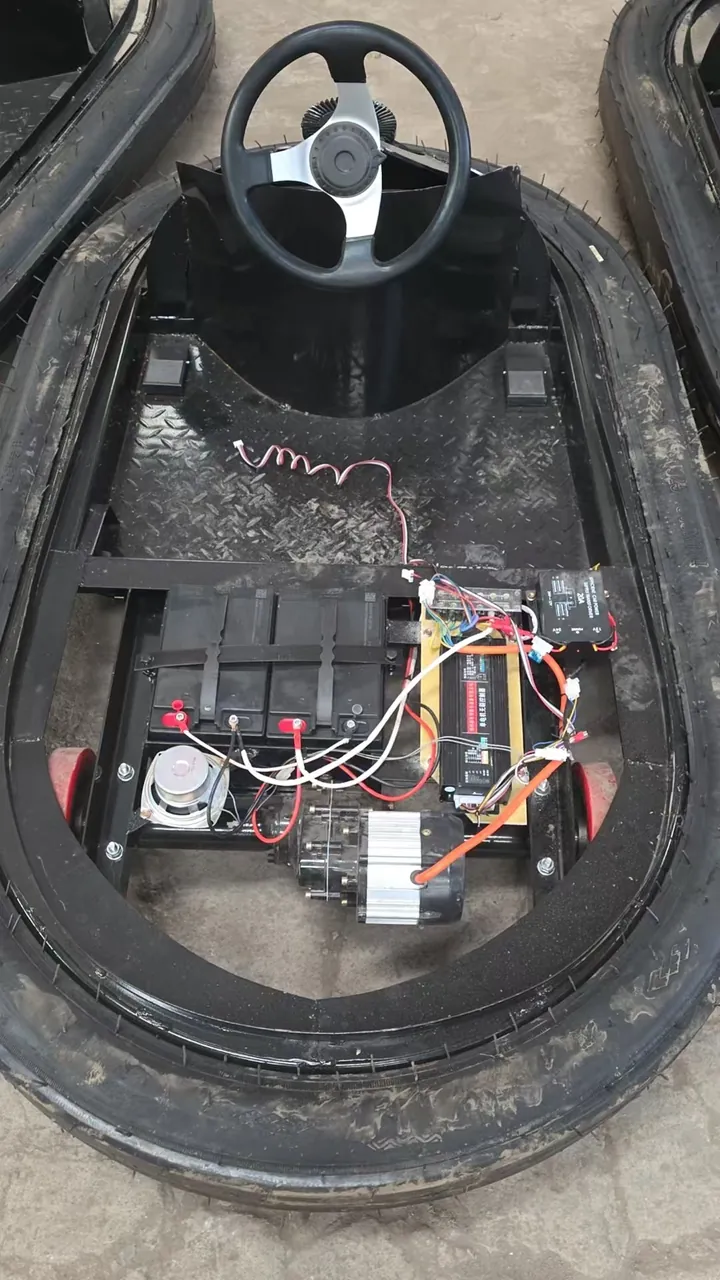
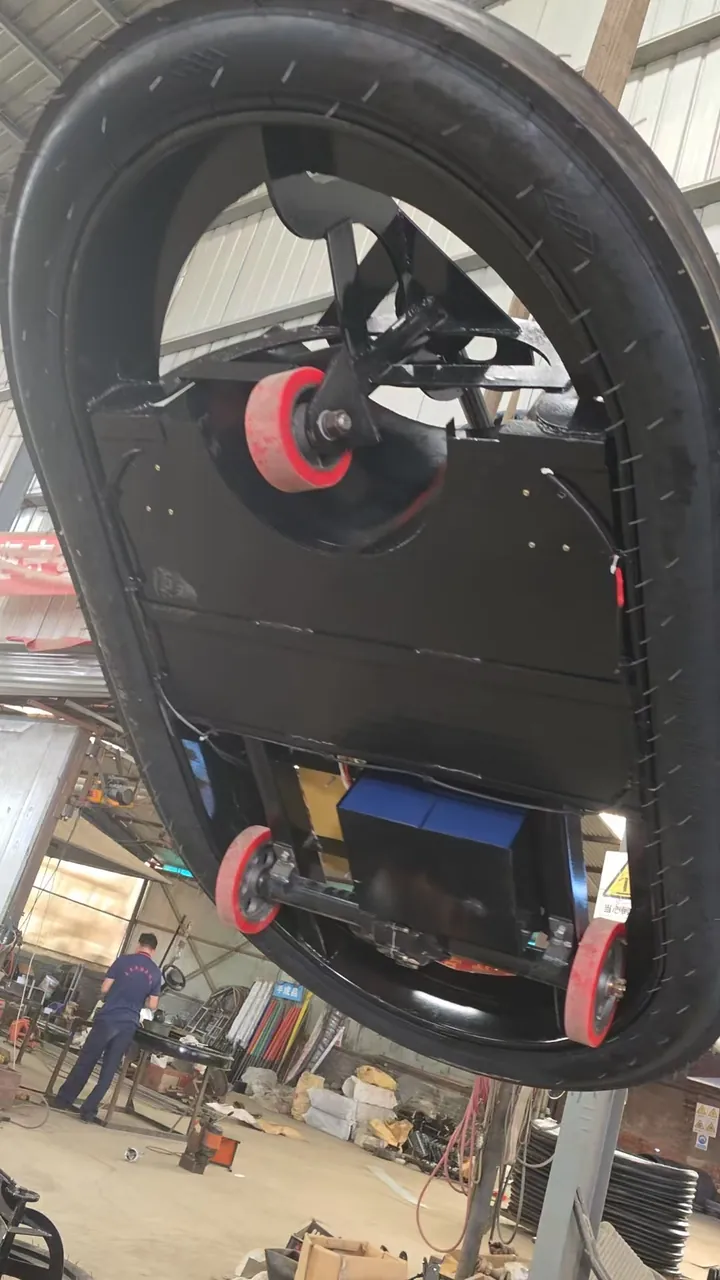
The trade-offs are honest ones: runtime per charge is finite, so busy venues keep spare batteries on rotation, and the collision punch is milder than a grid car pulling constant power. Batteries are consumables — budget for one replacement set every 2–3 years of hard use.
2. Floor Grid Bumper Cars (地网) — constant power, permanent arena
Floor-grid cars pick up low-voltage DC through metal brushes under the chassis, riding on conductive steel plates laid into the floor. Because power never runs out, the cars hit harder and run all day — this is the system for indoor parks that are in it for the long haul. The car itself shares the same platform as our grid models: 1.9 × 1.15 × 0.85 m, about 230 kg, 2 seats, LED lighting, front-wheel drive, soft leather seats, inflatable bumpers, and a ride timer adjustable from 0 to 10 minutes.
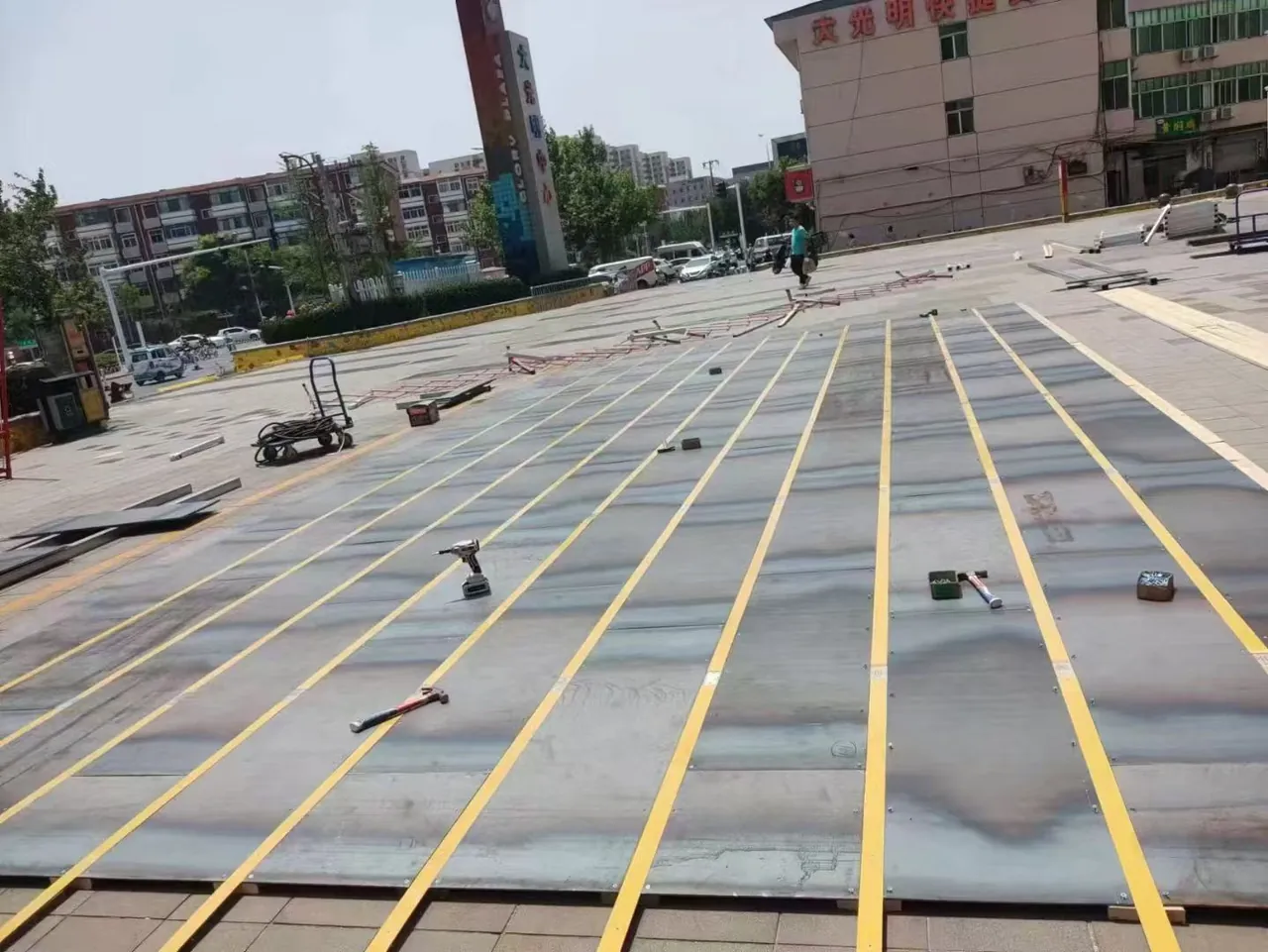
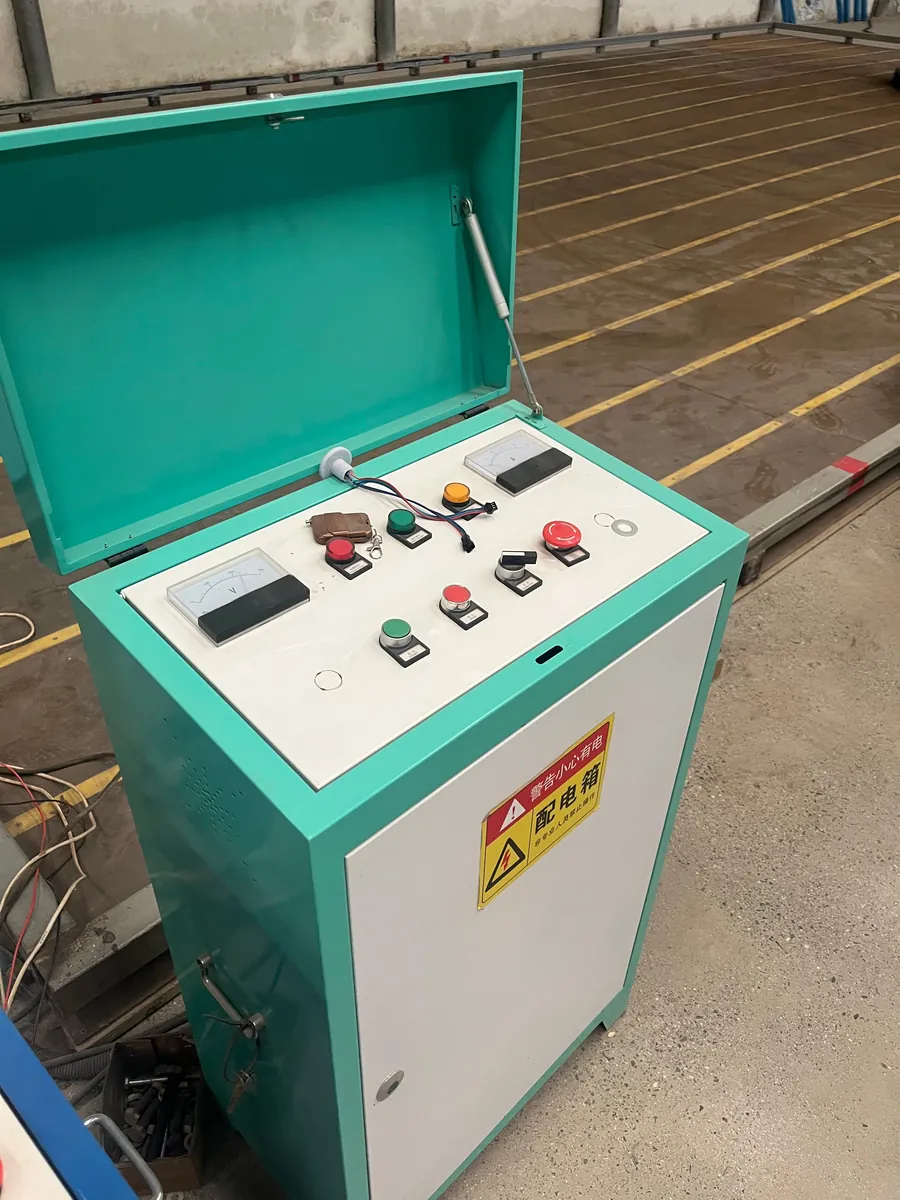
The catch is the floor. The conductive plate system (manganese steel or galvanized plate over an insulating layer) must be built to drawing, and it is permanent — you are renovation-costing the site, not just buying rides. Coastal buyers take note: steel plates in humid sea air need a rust-management plan. Maintenance in normal operation is cheap — mainly brush replacement and periodic insulation checks.
3. Ceiling Grid Bumper Cars (天网) — the classic, minus the floor works
The version most people remember from childhood: a pole on the car reaches up to a metal mesh ceiling (the “sky grid”) and draws power from it. Same constant-power benefits as the floor grid — strong drive, unlimited runtime — but your conductive surface is overhead, so the floor stays cheap plain concrete. The car specs match the floor-grid model, and a complete package includes the support pillars, top beams, perimeter fence, the mesh grid itself and the control cabinet.
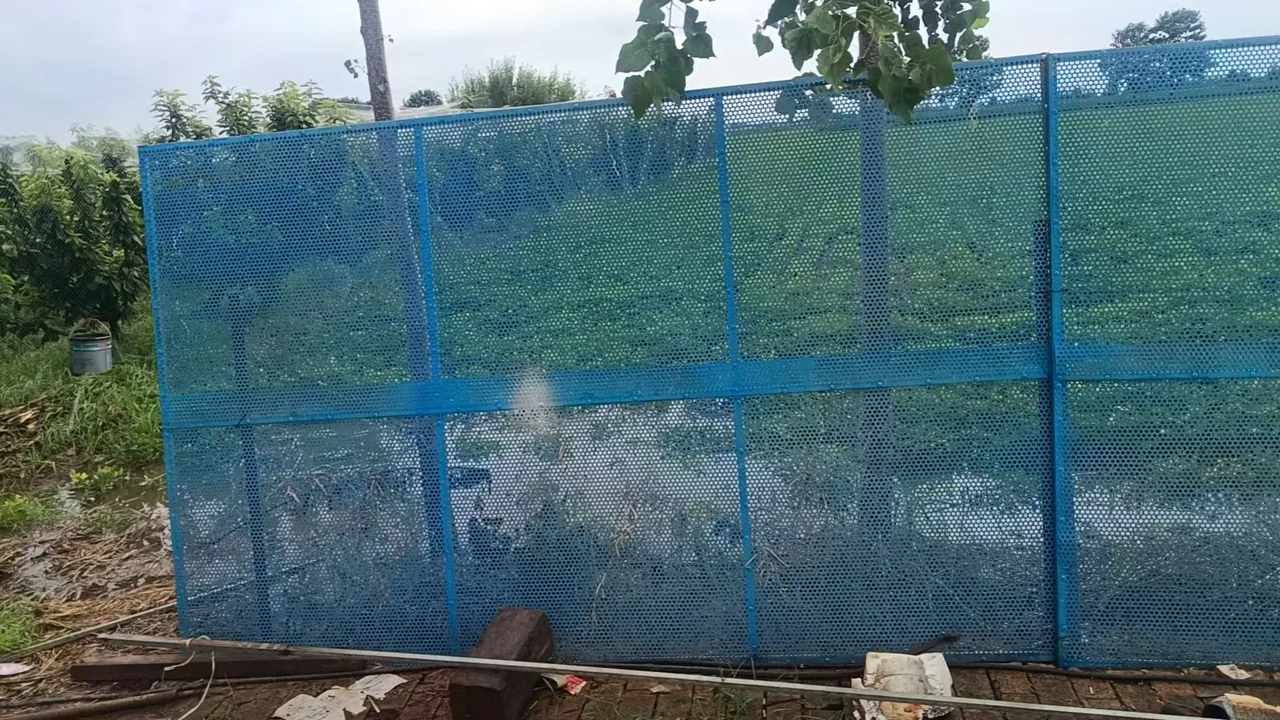
What to weigh: the steel structure is a real upfront cost, the poles and their contact parts are wear items, and the installation is fixed — this is not equipment you relocate next season. It also needs about 4–5 m of clear indoor height. Outdoor use in wind and rain is a no.
The Three Systems Side by Side
| Battery | Floor grid (地网) | Ceiling grid (天网) | |
|---|---|---|---|
| Site needed | Any flat concrete, indoors or out | Engineered conductive floor, permanent | Indoor, 4–5 m clear height, steel frame |
| Power & bump feel | Good, milder collisions | Constant, strongest | Constant, strongest |
| Runtime | Per charge (swap batteries to continue) | Unlimited | Unlimited |
| Weather tolerance | Fine outdoors, no exposed contacts | Dry indoor use; plates rust in coastal humidity | Indoor only |
| Moving it later | Easy — it is just cars and chargers | Fixed | Fixed |
| Best for | First-time operators, rented sites, coastal & rainy areas, pop-up events | Permanent indoor parks, high-traffic venues | Indoor venues with budget for structure and classic look |
How Many Cars Do You Actually Need?
New buyers consistently order too few. The arithmetic we walk through with customers: a 3–5 minute cycle including loading, 1.5–2 riders per car when you allow doubles, and realistic uptime of 30–40 minutes per hour. A 10-car arena clears roughly 180–280 riders in a good hour; a 20-car arena can double that — if the floor area matches. Each battery car needs about 1.5 m² of parking footprint, but budget 8–10 m² per car of arena space once you include room to actually bump. For most FECs the sweet spot is 12–16 cars: enough for two or three waves of regular riders, small enough to fill on a Tuesday.
One more tip from the workshop: order a spare-car worth of parts with every 10 cars. We put a start-up spares kit in every shipment, but arenas run hard, and the operator who can swap a brush or a tyre on the spot never loses a Saturday.
What Bumper Car Setups Actually Cost
Indicative ex-works prices from our 2026 quotations (USD). Your specification, order quantity, theming and shipping move the final number:
| Setup | What is included | Indicative range |
|---|---|---|
| Battery car, per unit | 2-seat, 500W, 2 × 12V 60Ah, FRP shell, LED | $850 – $1,500 / car |
| Grid car, per unit | 2-seat grid car (floor or ceiling); power system quoted separately by site | $1,400 – $2,400 / car |
| Kiddie battery set, 8–10 cars | Small battery cars, arena border, chargers | $6,000 – $18,000 |
| Standard battery arena, 12–16 cars | Full-size battery cars, LED lighting, border, chargers, spares | $18,000 – $45,000 |
| Floor-grid arena, 16–24 cars | Grid cars, engineered floor-system drawings, control cabinet, border, spares | $40,000 – $100,000 |
| Ceiling-grid arena | Cars plus pillars, beams, mesh grid, fence, control cabinet | $80,000 – $180,000+ |
Sea freight typically adds 8–15% depending on distance; a 16-car battery arena usually fits two to three 40-foot containers with border and spares. If a quote lands far below these ranges, the savings are coming out of the steel, the motor windings or the fiberglass — none of which show up on day one, all of which show up by month six.
The Parts That Break (and What to Stock)
After building and supporting these for years, the wear map is predictable: tyres and inner tubes take the most abuse, floor-grid brushes and ceiling-grid poles wear on contact, and controllers occasionally fail after seasons of hard bumps. Steering wheels, gears and boards are all replaceable — the photo below is the spare-parts board we take to trade shows.
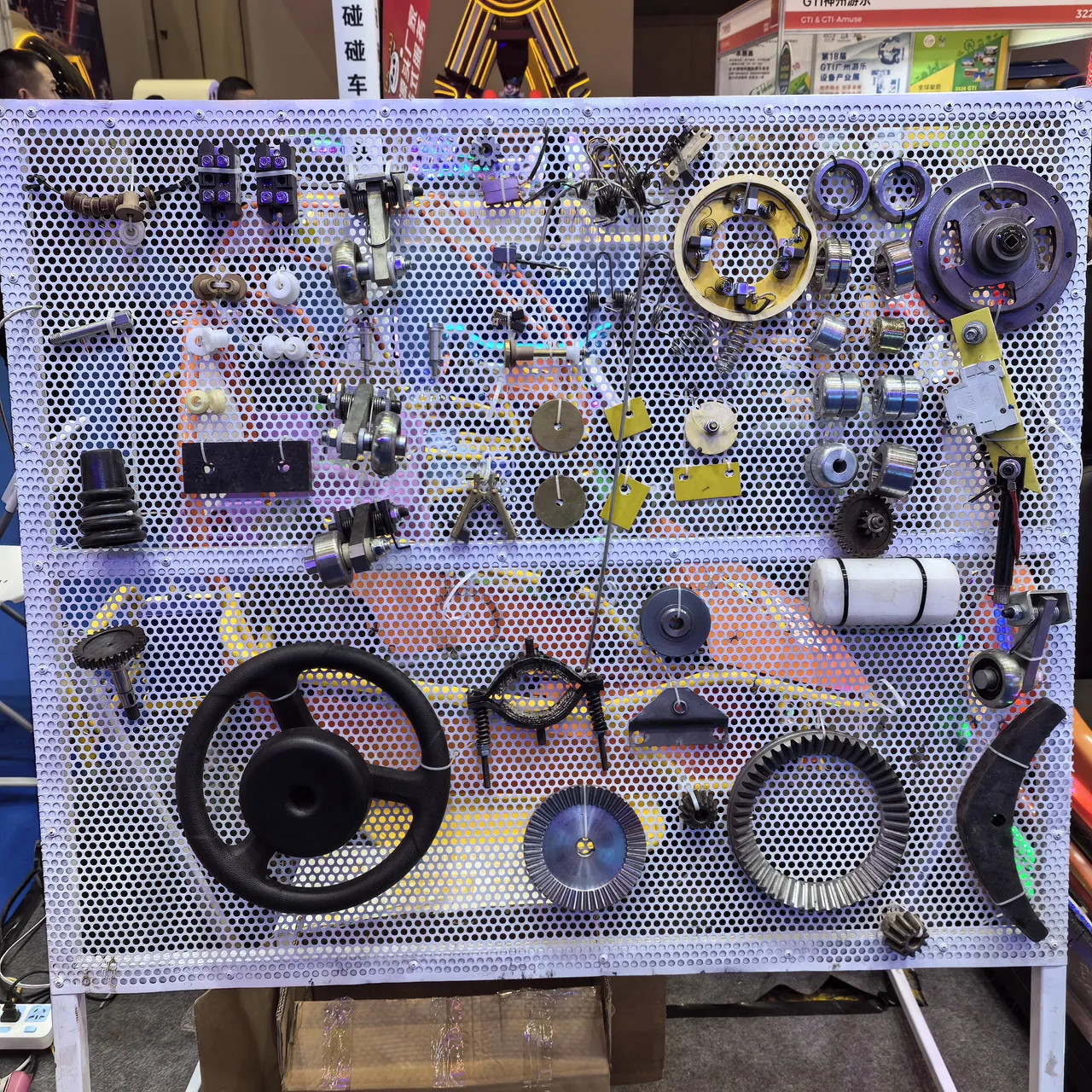
Stock per 10 cars: a set of tyres with tubes, two or three pairs of brushes (grid systems), one spare controller, fuses and a steering wheel. It is a few hundred dollars that protects your busiest weekends.
The Five Mistakes We See Every Season
- Buying on car count alone. Ten heavy, well-built cars beat sixteen flimsy ones; guests feel weight and speed immediately.
- Ignoring the floor until the week of installation. Floor-grid systems need the slab prepared in parallel with production, not after.
- Underestimating charging logistics for battery cars — plan the charging racks, ventilation and sockets into the room.
- No spare tyres or brushes on site. They are consumables; running out on a holiday weekend is self-inflicted.
- Forgetting the exit flow. Riders and the next group cross paths in badly planned arenas, and throughput dies right there.
How We Build Them at Henan Xinlong Amusement Equipment Co., Ltd.
Cars go down our line as welded steel chassis, get hand-laid FRP bodies, LED lighting as standard, and a factory run before packing. Grid arenas ship with floor-system and layout drawings for your site, the control cabinet, a start-up spares kit, and English-speaking engineers on video or on-site for installation.
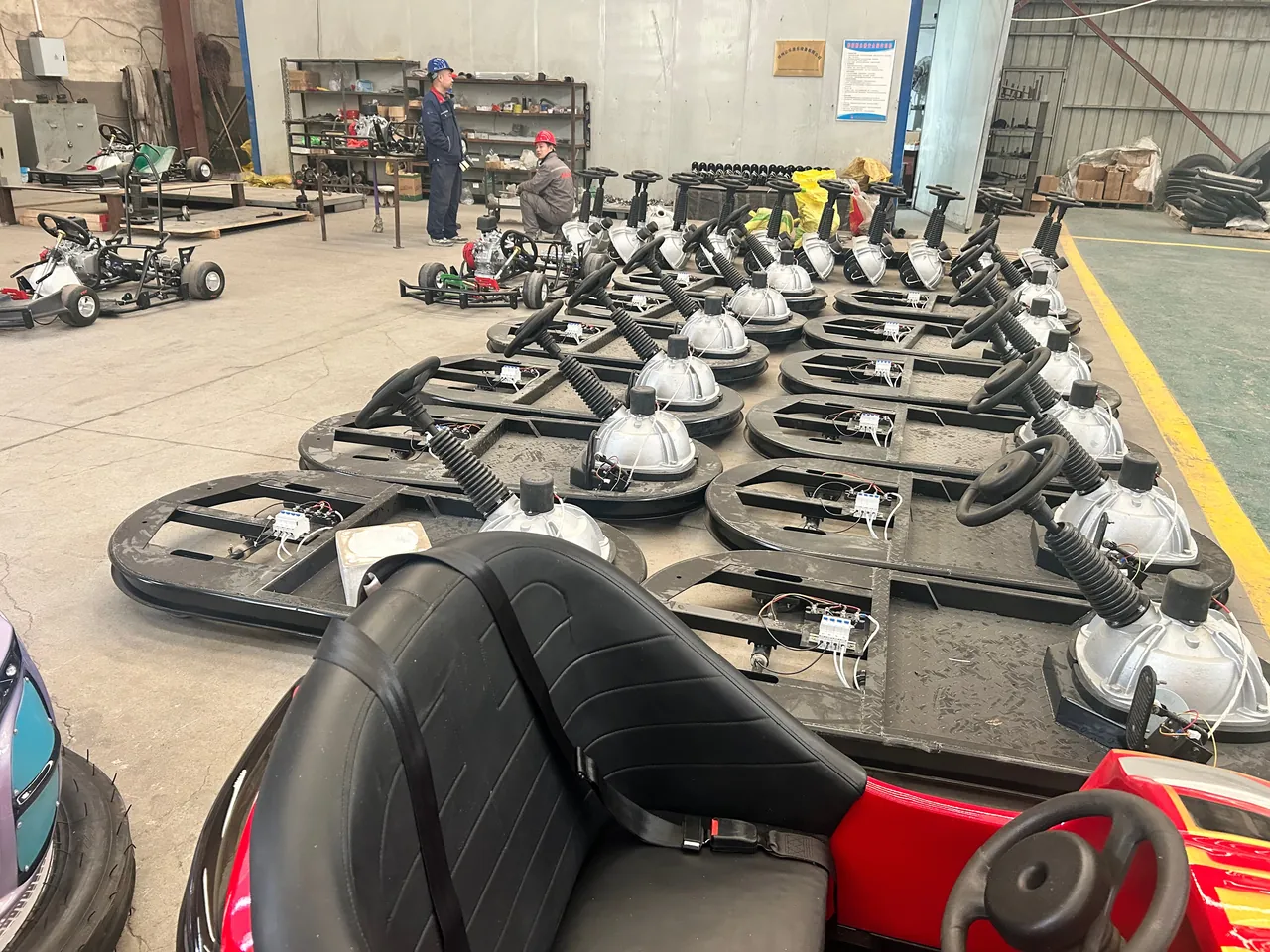
Tell us your room dimensions, indoor or outdoor, and your budget on WhatsApp — we will tell you honestly whether 12 or 20 cars makes sense, and which of the three systems fits your building.
Frequently Asked Questions
Battery, floor grid or ceiling grid bumper cars — which should I buy?
Battery cars suit first-time operators, rented sites, coastal humidity and outdoor use — no construction, just flat concrete. Floor grid suits permanent indoor parks that want maximum power and all-day runtime. Ceiling grid delivers the same constant power with a cheaper floor but needs 4–5 m indoor height and a steel structure budget.
How much space do I need for 10 bumper cars?
Roughly 100–150 m² including circulation and the arena border, on a flat concrete slab. A 20-car arena wants 200–300 m². Each car parks in about 1.5 m², but the arena needs room to bump — cramped floors cut both fun and throughput.
How much does a bumper car cost?
Indicative ex-works: $850–1,500 per battery car, $1,400–2,400 per grid car. Complete arenas run from about $18,000 (12–16 battery cars) to $100,000+ (large floor-grid or ceiling-grid systems). Sea freight adds roughly 8–15%.
What is included in a bumper car arena package?
From us: the cars, control cabinet (grid systems), chargers, arena border, start-up spares kit, floor-system and layout drawings for grid arenas, packing matched to container volume, and installation support by English-speaking engineers.
Buying a ride is a 10-year relationship with a factory. Choose the partner, not just the price.
Get Personalized Advice
Our engineers answer buyer questions daily — site fit, budgets, documents for your market.